
Showing posts with label engagement. Show all posts
Showing posts with label engagement. Show all posts
Monday, May 16, 2022

Tuesday, September 21, 2021
Increasing Engagement with Formative Assessments

I'm always thinking about how can I improve students learning without overwhelming them. We just finished up prioritizing standards last spring and it just makes sense to evaluate my formative and summative assessments that I administer to my classes. Obviously, this is also the schools main building goal but making it my ICDP will make me focus on it even more. Changing things can be hard but also rewarding and going back and looking at my completion data of formative assessment, and how I can be more impactful with less work seemed like a good place to start. I believe that I give too much homework to my students, and how can I give less homework but provide more formative assessments in-class to grade their understanding. I also want to tier my summative assessments and change the nature of my questions to challenge them to think more metacognitively. My overall concern is participation, I want students to participate more during in-class learning, and I would like students to be challenged more to think creatively and make connections to other world events. Creating meaningful activities in-class may generate the outcome I'm looking for.
I do believe students will develop a better understand of course material if more formative assessments are given in-class. I also believe that knowledge will spill over into their summative evaluation of the standards and create more in-depth thinking. When it comes to resources dealing with these topics there are a lot to look at. Finding the best ones will take some time. I have already received some resources from you, and will continue to ask other teachers in the building especially ones that are in my curriculum area. I will also search credible sources online. By the end of the semester I will send out a survey to the kids to see if the in-class learning was effective for them and helped them also with their summative assessments. I will discuss with my AIW team and curriculum team my summative assessments, and what I need to do to improve my questioning or the way I tier those assessments. Overall, I believe that if I lessen the load of homework and bring it into the classroom not only will I see better participation but less stress in students which is also a main focus of mine!
Monday, September 20, 2021
Participation and Engagement
 |
| Teacher studying school books in class with high school kids. Stock Photo. Clipart.com School Edition, Vital Imagery Ltd., 01-03-2019, https://schools.clipart.com/download.php?iid=1585346&tl=photos. Accessed 20-09-2021. |
My plan for the year is to improve student participation and engagement in my classroom. Two years ago Meg read the book Total Participation Techniques and asked me to do a coaching conversation with her on how she was going to implement some of the strategies in her classroom. I found our conversation to be very interesting and decided to read the book myself. My plan was that this would be my ICDP last year, but Covid and Canvas took more of my attention and focus, which was necessary for the time.
I believe many of the strategies in the book will pair nicely with formative assessment, which is a piece of our building goal this year. By having more students fully engaged in the task, I will (should!) be better able to assess who is understanding the information and who is confused. If I can successfully redirect and reteach in the moment, ideally more students will understand the information and be able to pass standard assessments the first time, which will lead to less need to reassess. I don't have good hard data from the past on reassessment. I could try to dig in and find what we were working on before we ended 2020 with Covid. For sure, I can compare first semester to second since all of my classes repeat.
Sunday, November 15, 2020
Online Teaching with Engaging Tasks
January 2021
Digital Tool: Kahoot
I had learned about Kahoot at least 5 years ago and had some experience using it as a player at various staff meetings. I have to admit, I did not enjoy this tool. The idea of competing is something I do not enjoy unless it is against myself. But . . . I decided to give it a try to try to engage students in a new way to practice their vocabulary words from our shared story. After hearing from various families about how much fun the kids had playing, I decided to use it sporadically.
I also used it as an introduction to a Social Studies lesson about laws and rules and then also as a review of shape names.

I can imagine continuing to use Kahoot back in building for all the reasons I used it before, but also as a getting to know you activity. Online it did present a challenge for my beginning readers and therefore I had to create videos to say the question and answers rather than just expect them to read it. That part did take extra time, but back in the classroom I could just read it outloud.
December 2020
Digital Tool: Flipgrid
Flipgrid was a tool that I had been exposed to over the last couple years. I had used it as a way for kids to share their creations during Makerspace and STEM times. We had used it also with a class that we connected with through Global Read Aloud. This tool was super important to during my Online teaching in order to build relationships with and learn about my students. I used it most often as an Engage when students first logged onto their module for the day.
I would use it to ask getting to know you type questions, shout outs (affirmations), share things they were proud of, reflections of their learning, book recommendations, reading responses, share writing and their creations. I am happy with the variety of ways that I thought of to use it in many different areas of academics. I also used it one time to app smash with book creator so kids could share their published writing.
One thing I'd like to do better with Flipgrid is to get kids to listen to their peers' videos and respond. I think if I would consistently say, "listen to 2 friends' videos and respond", that would have been enough to prompt them to do it. Also, if I would have been better at getting on and approving videos more often throughout the day that would have helped because they couldn't see their peers' videos until they were approved.
When I return to in building teaching I would like to continue to use Flipgrid to build relationships within the class, share affirmations, things they are proud of, maybe even as an exit ticket, or an enter ticket into the classroom in the morning. Flipgrid might also be helpful as a formative assessment tool.

November 2020
Digital Tool: Seesaw
Seesaw has probably been THE most important digital tool that I've used as an Online Teacher. As an on-site teacher I used it mostly to share student work with families and mostly just used the journal feature. Now however, I can't imagine not using the activity feature ALL of the time. First, it was how I was able to efficiently keep track of student work and know what assignments were missing from which students.

Seesaw enabled me to build and continue to grow relationships with my students. I had read research in August that said that verbal feedback was much more meaningful to students virtually than written. They could hear the love in their teacher's voice and my beginning readers were able to understand the feedback and grow from it. This quickly became the only way I left feedback for students (except for a digital sticker once in a while). I especially used this with math and writing work. I tried to leave feedback for at least 1 piece of work turned in every day. I think it was helpful that families could hear my feedback also and then be able to help their child to fix whatever mistakes they had or continue to help them grow.

I used Seesaw to keep track of all Self Paced Math work. I will definitely continue this routine in the building.

Another beneficial routine that I will continue on site teaching is having students share their daily writing and read it out loud also. This brings accountability, an audience, and the reading/writing connection.

Online teaching also enabled me to bring in more grammar and language lessons that I never seemed to be able to find time for on site. I will use a video at the beginning of the Seesaw activity and then a practice activity to more efficiently fit these into my curriculum and class time.

One other consideration I still need to reflect on is how I used Seesaw to help me differentiate my weekly story problems. Usually the kids were given a colored strip to match their needs to glue into their math notebook and then turned their notebooks in at the end of the day. During Online teaching they were assigned a certain activity and the background color matched the color strip they would have been given. One benefit was that students then were encouraged and given the ability to use the microphone to explain their thinking. If communication of their thinking is an emphasis in math class, I think I have got to continue this routine to give ALL kids, EVERY week the opportunity to communicate their math thinking.
October 2020
I was able to attend Capturing Kids Hearts Excelling Virtually LIVE professional development in October with about 20 - 30 Nevada colleagues through Zoom. The major ideas were:
Keep it connected
Keep it engaging
Keep it simple
I left with SO many new exciting ideas. First, make sure that during LIVE sessions students feel SEEN;
smile, eye contact, energy and names. I was mostly doing these things regularly but now I had
confirmation about how important they were. Next, in order to help keep online learning connected to the
school I set a goal for myself to post 1 thing each week on twitter with the #nevadacubpride and
#onlinelearners and talked some of my online teacher colleagues into trying it too. It is important to me
that our school district and community know that the online students are working hard and learning too!
I also set the goal for engagement and connection for me to hold a surprise and delight once a week for
the online learners. So far I’ve done Lunch Bunch, a tangible gift in their materials bag, LIVE directed
drawing, LIVE math game, and this past week invited a guest teacher to join us for a LIVE lesson.
The other thing that we realized was super important for engagement and learning was to be able to use
breakout rooms and some of the other features we saw available on Zoom during that professional
development. I contacted the tech team immediately and they were willing to buy us what we needed so
that we could use breakout rooms.


Digital Tool: Google Meet
Google meet is a video-communication service that provides real-time meetings. They are super helpful
and now open the door for collaboration among students and more engagement. I’d still like to explore
more features including polls. I plan to explore using google meet break out rooms for individual
conferences during Read to Self times and individual conferences during Writing Workshop time.
I’ve used the breakout rooms for
1. guided reading small groups for during individual reading times
2. class meeting games when someone is "it" and has to come back to the whole group to guess
something
3. digital BreakoutEDU session so that I could students in small groups and assign them a lock to work
on as a group.

10/5/20 - Kids in class meetings are smiling, talking to each other, using names, I felt the joy; Rock Paper Scissors type game was a hit
September 2020
9/21/20 - Conversation with Carrie about story problem sharing out, able to open jamboard and google
meet at the same time, record using quicktime
9/22/20 - Used Jamboard for the first time today to have Evan and Leo share out their story problems.
Worked well! Had to make sure I gave editing privilege
From here I rearranged my weekly schedule for math to give myself a day in between Day 1 of the story problem where students first solve the problem of the week and Day 2 where students share out and then student goals are differentiated. This way I have a day to contact the students that I want to record their strategies and then get them uploaded to Canvas for their classmates to view the next day. This has worked well and students like sharing out.
Digital Tool: Jamboard
A Jamboard is basically a whiteboard you can share with students synchronously or asynchronously and give everyone editing capabilities. I've used Jamboards for:
1. LIVE Guided Writing planning

2. Student's sharing out their problem solving strategies. I did these 1 on 1 for the week's story problem with 2 sharers and recorded their sharing out using QuickTime. Then I uploaded videos to youtube and put them in the Canvas module for the next day for the class to watch before they started their second day of their story problem.

3. LIVE small group math time for number sense work

4. Social Studies sharing out and building prior knowledge

There are so many more uses to Jamboards and I'm sure over time I'll explore them. I can DEFINITELY see using Jamboards in face to face instruction for allowing more students to share out their thinking and ideas. The sticky note feature is nice for organizing data for everyone to see. One issue though that I see is that beginning writers and readers may not have as much access to this tool. It does allow pictures to be uploaded.
I'd like to try Jamboards for social-emotional and academic check ins next.
More Jamboard Templates for distance learning
August 2020
When I got the call that I was one of the 4 teachers selected to be an online teacher for the 2020 - 2021 school year I was relieved, anxious, sad, and excited all at the same time for this new teaching journey that I was about to go on. I promised Chris that I would do the very best job that I could. I also had no idea the challenges and successes that were to come. It only made sense since I was beginning this journey that my ICDP goal would be. . .
During the 2020 -2021 school year I will research and implement how to teach online with the focus on creating engaging tasks so that online learners are motivated to learn and achieve.
We had so many questions to answer and no idea how to begin other than the Canvas course we'd taken with Carrie in spring of 2020 "just in case". We wondered;
1. How much time should students be expected to be online watching videos not including independent time to work?
2. How to be equitable for all our learners?
3. How would we do state testing?
4. What could instruction look like?
5. Attendance policies
6. Specials?
7. Special education services?
8. How to get books in students' hands?
9. How to get students' weekly materials to them?
10. Office hours?
11. Collaboration time with grade level PLC and other online teachers
12. How much time in LIVE small group lessons each week?
13. Digital tools we'll need?
14. How do we build relationships online?
15. How do we implement many of the Capturing Kids Hearts key ideas online?
and on and on and on. Slowly we got some answers, made some up of our own, and continue to change as we go. This is a reflection of my year long journey of teaching online, focusing on engaging students and trying to look forward to how I would use these tools and strategies face to face also. I hope you find some pieces that would help you and also see the joy in "building the plane as you fly."
Sunday, November 17, 2019
Implementing my teaching mission statement
Reflections and More To Do
This year I tried to pull together lots of different pieces of learning that I’ve had over the last few years, dig into them deeper, and be intentional about implementing them to try to design my classroom to live out my teaching mission every.
Beginning October 2019 Integration Phase

Other goals/ ideas
Summer 2019 - plan for integrated Science and Social Studies
Year Long - implement 1 PBL project
Year Long - pick out big concepts, revise year-long theme essential questions and big ideas and implement
Year Long - revise math canvas units and implement a spelling self-paced unit
Year Long - continue to evaluate use of blended learning in the classroom
9/2019 Research Phase
 When I began to think about how to fit it all together I decided I needed to reread more deeply the Susan Kavolik book about Integrated Thematic Instruction. There are SO many important ideas in this book and some new key take aways and applications that I began to use right away were;
1. Kavolik opens the books with a list of mismemes about education. The one that stuck with me the most is; "Acquisition of Knowledge and Skills is the goal of education" instead Kavolik believes . . .
The purpose of Public Education is the Perpetuation of Democracy - our country would be better served by schools that produce caring, intelligent, wise citizens who willingly engage in the work of a democracy, rather than schools that produce graduates that do well on isolated subgoals. The main goal is to show Ss how to connect learning with the real issues of their surroundings, than solve problems. Education for citizenship, teachers need to orchestrate opportunities for doing the real work of a community. I believe Kavolik would support Project Based Learning and Authentic Intellectual Work.
2. Focus on a year-long theme, continue to come back to the essential questions and key points often. I've done this for nearly 18 years, but this year would be more than ever. To do this I first had the theme wall in a corner of the room and decided that it wasn't easily accessible to students or myself so I moved it front and center to the whiteboard by our whole group area. I put up big concept words for each essential question and have taken pictures to make our learning more visual. We talk about it almost daily and I intentionally plan for the connections to theme more than I have before.

3. Kavolik focused a lot on the importance of relationships with students, another reason for me to slow down and make sure I'm continuing to do the essentials of Capturing Kids Hearts in my classroom everyday.
4. Kavolik devoted a chapter to teaching life skills, many of which are our Nevada Learner Outcomes. I had all of them on my year long plan to teach except pride. Need to think more about this one.
5. Kavolik suggests eliminating regular schedules with their specified time blocks. I've begun to blend my literacy and math work times to give students choice about the tasks they complete. I use a work menu that allows students to make choices and practice responsibility and prioritizing. I began the year with a station rotation model, but sooner than years before, we quit the rotation model and moved to the work menu. We've had to have lots of discussions about work time expectations and practice those again and again.

Some things I need to continue to grow at;
1. Dig deeper into writing key points and inquiries and assessment of them.
Lasting thoughts from the book; Anything less than preparation for life is a waste of both student and teacher time and effort.
Other resources I used this year:
Summer 2019 - PBL training
Nevada PhD - Canvas session by Carrie HIllman and Joe Wakeman to learn about badgr and mastery pass
Fewer Things Better by Angela Watson
Best Practices at Tier 1 - Daily Differentiation for Effective Instruction by Mike Mattos
Teach like a Pirate by Dave Burgess
11/17/20 ICDP Goal Creation and Why
A few years ago on a TLC professional development day, we began to learn about creating a teaching mission statement and given time to create a draft and share it with colleagues for feedback. For years it sat in a frame on a shelf in my classroom. I looked at it when I'd have a bad day to remember the big picture and what my "why" was. This year I decided to focus my ICDP goal on trying to live out my teaching mission because the last few years I've been attending professional development on SO many great strategies and models and trying to make them all fit has been such a struggle. This got me to take a step back and begin to think about what I believe is most important and this led me back to my teaching mission statement. This statement is the lens that will help me decide what is valuable to have and use in my classroom and what to begin to do less of and even leave out. This is the first blog post of my journey toward living out my teaching mission statement.

This year I tried to pull together lots of different pieces of learning that I’ve had over the last few years, dig into them deeper, and be intentional about implementing them to try to design my classroom to live out my teaching mission every.
I tried to run my classroom as much as possible throughout the day as a workshop, empowering kids through work menus and choices. I continued to use and build better self-paced learning and blended learning environments. Because of extenuating circumstances, my class was in the middle of 2 PBL units and we were not able to complete them. We were planning a school-wide Makerspace Monthly Challenge and also planning to build a fence for Noah’s Garden. The thing I am most proud of is that my MA 1-2 team gamified a Social Studies unit during our PLC time to give students real life experience in trading, natural and man-made resources, regions, and supply and demand. This was no easy undertaking but we all really thought it was worthwhile and am already thinking of a game for next year.
This goal is never-ending and will never be perfect. Next year I want to continue the workshop models, but make them more manageable for the teacher. I need to remember to go slow when teaching the workshop routine; model, support, and scaffold expectations and how to problem solve. I will continue to teach thematically, bringing out Science and Social Studies concepts all through the day and continuing to reflect on Kavolik’s big ideas. I will continue to implement PBL units (possibly another garden focus and Makerspace Monthly Challenge) with intention as well as self-paced and blended learning to meet students where they are and to help them own their learning. I will continue with the goal of taking students TO the Makerspace once a month next year, but I will also remember to bring makerspace materials TO the classroom (maybe in a big tub) and teach students how to manage that independently.
One exciting next step is that I recently ordered a book called, The Curious Classroom: 10 Steps for Teaching with Student-Directed Inquiry by Harvey Daniels. I am ready to get reading and planning for integrating his steps next year. I'd also like to collect absenteeism data to see if my attendance rate is going up because of the changes I'm making in the classroom. I also want to give a likert scale to kids 3 times per year to gauge their feelings toward each subject and school. Next year I want to create rubrics for thematic projects and also continue to be intentional when planning for learner outcomes and 21st century skills.
10/1/20 -- Decided to have spelling tests every 2 weeks this year instead of every week
10/22/19 -- Without prompting Ss are moving forward with their self-paced fall unit. It’s so great to have
2nd graders be able to show the first graders the way. I am not needing long for the first unit, Ss could
be done in 2 weeks but I’m giving them 3. Need to get Level 3 geometry ready. Ask Carrie how to copy
so I can use it.
2nd graders be able to show the first graders the way. I am not needing long for the first unit, Ss could
be done in 2 weeks but I’m giving them 3. Need to get Level 3 geometry ready. Ask Carrie how to copy
so I can use it.
11/6/19 — Introduced self-paced level charts. Told kids to look at who is in group and if have questions,
ask someone in their group because they are going through it too. 2nd grade student did! Looked up at
chart and then turned to a 1st grade student and asked for help during work time!
ask someone in their group because they are going through it too. 2nd grade student did! Looked up at
chart and then turned to a 1st grade student and asked for help during work time!
11/12/19
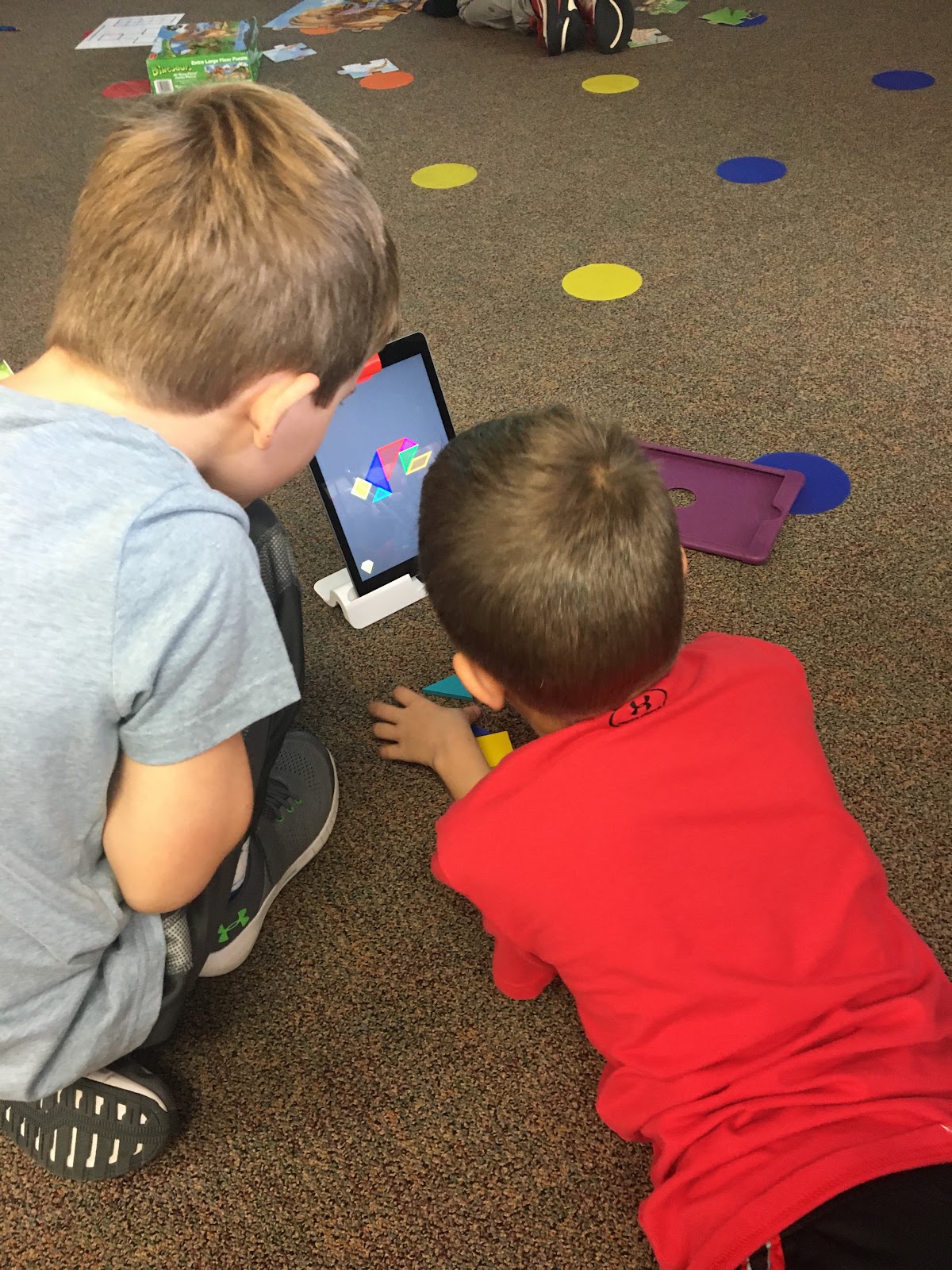
Picture of kids doing a puzzle together and a STEM challenge in class.
This is the first day it really ran the way I envisioned it. I introduced Eiffel Tower building challenge for the
week with a 1 minute video. I also put it on Canvas they could watch longer, but they weren’t interested
yet. This is the first time 2nd grade boy and 1st grade girl have EVER put together a puzzle. They really
did NOT understand the idea of making a frame or looking for straight side or similar colors but they
worked on it for 30 minutes and cheered when they finished it! 2nd grade boy and 1st grade boy used
Tangram Osmo when they finished their work time for nearly 30 minutes also.
New ideas: Kids DO have focus, attention, stamina, problem solving skills when it is something they are
interested in and motivated to do .
interested in and motivated to do .
1/2/20 Coaching Corner - 2 yoga ball chairs in the corner
Picture of 2nd grade girl waiting for a coach
1/6/20 Decided to change the format for responding to building challenges to Flipgrid. Took some time
to learn exactly how to use Flipgrid and I think students will enjoy 1 place they can go to to see all of the
challenges and responses. The next step is that I’d like the kids to take ownership of sharing out the
challenge with other classrooms. Maybe talk to them next week about who they’d like to invite to the
uilding challenges and have them go to the classrooms to explain. Maybe have the student of the week
pick the challenge? Would like to introduce a new challenge every new work menu, so about every 2
weeks.

Bring the makerspace materials TO the kids and they will build!!
My goal was to make it to the Makerspace at least 1 time/ month this year and I announced this goal to
the class with the hopes that they would help keep me accountable. This one was in January with a
challenge to make the vehicle go the farthest. We DID go every month that we had school this year,
sometimes with a challenge, sometimes with just free range of the materials. If it was getting late in the
month, 2nd grade boy was always the one to remind me of my promise.
1st and 2nd grade MA teachers worked to gether to create a game to address Social Studies standards.
It was called Community Survivor and involved natural resources, scarcity, regions, and trading. We
implemented the game for 4 days before spring break.
It was called Community Survivor and involved natural resources, scarcity, regions, and trading. We
implemented the game for 4 days before spring break.
Other goals/ ideas
Summer 2019 - plan for integrated Science and Social Studies
Year Long - implement 1 PBL project
Year Long - pick out big concepts, revise year-long theme essential questions and big ideas and implement
Year Long - revise math canvas units and implement a spelling self-paced unit
Year Long - continue to evaluate use of blended learning in the classroom
9/2019 Research Phase

1. Kavolik opens the books with a list of mismemes about education. The one that stuck with me the most is; "Acquisition of Knowledge and Skills is the goal of education" instead Kavolik believes . . .
The purpose of Public Education is the Perpetuation of Democracy - our country would be better served by schools that produce caring, intelligent, wise citizens who willingly engage in the work of a democracy, rather than schools that produce graduates that do well on isolated subgoals. The main goal is to show Ss how to connect learning with the real issues of their surroundings, than solve problems. Education for citizenship, teachers need to orchestrate opportunities for doing the real work of a community. I believe Kavolik would support Project Based Learning and Authentic Intellectual Work.
2. Focus on a year-long theme, continue to come back to the essential questions and key points often. I've done this for nearly 18 years, but this year would be more than ever. To do this I first had the theme wall in a corner of the room and decided that it wasn't easily accessible to students or myself so I moved it front and center to the whiteboard by our whole group area. I put up big concept words for each essential question and have taken pictures to make our learning more visual. We talk about it almost daily and I intentionally plan for the connections to theme more than I have before.

3. Kavolik focused a lot on the importance of relationships with students, another reason for me to slow down and make sure I'm continuing to do the essentials of Capturing Kids Hearts in my classroom everyday.
4. Kavolik devoted a chapter to teaching life skills, many of which are our Nevada Learner Outcomes. I had all of them on my year long plan to teach except pride. Need to think more about this one.
5. Kavolik suggests eliminating regular schedules with their specified time blocks. I've begun to blend my literacy and math work times to give students choice about the tasks they complete. I use a work menu that allows students to make choices and practice responsibility and prioritizing. I began the year with a station rotation model, but sooner than years before, we quit the rotation model and moved to the work menu. We've had to have lots of discussions about work time expectations and practice those again and again.

Some things I need to continue to grow at;
1. Dig deeper into writing key points and inquiries and assessment of them.
Lasting thoughts from the book; Anything less than preparation for life is a waste of both student and teacher time and effort.
Other resources I used this year:
Summer/ Fall 2019 - reread Susan Kavolik’s ITI: The Model, Integrated Thematic Instruction
Nevada PhD - writing workshop session with Amanda and DebbieSummer 2019 - PBL training
Nevada PhD - Canvas session by Carrie HIllman and Joe Wakeman to learn about badgr and mastery pass
Nevada PhD - Makerspace session with Carrie Hillman
Teach Outside the Box - Enlightening Young Engineers blogFewer Things Better by Angela Watson
Best Practices at Tier 1 - Daily Differentiation for Effective Instruction by Mike Mattos
Teach like a Pirate by Dave Burgess
11/17/20 ICDP Goal Creation and Why
A few years ago on a TLC professional development day, we began to learn about creating a teaching mission statement and given time to create a draft and share it with colleagues for feedback. For years it sat in a frame on a shelf in my classroom. I looked at it when I'd have a bad day to remember the big picture and what my "why" was. This year I decided to focus my ICDP goal on trying to live out my teaching mission because the last few years I've been attending professional development on SO many great strategies and models and trying to make them all fit has been such a struggle. This got me to take a step back and begin to think about what I believe is most important and this led me back to my teaching mission statement. This statement is the lens that will help me decide what is valuable to have and use in my classroom and what to begin to do less of and even leave out. This is the first blog post of my journey toward living out my teaching mission statement.

Subscribe to:
Posts (Atom)